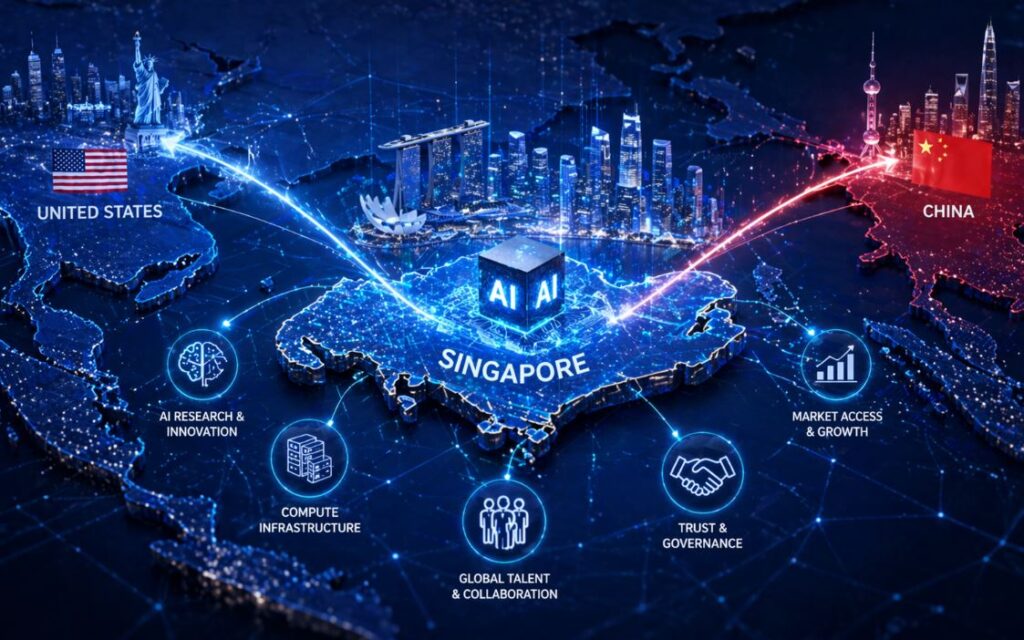
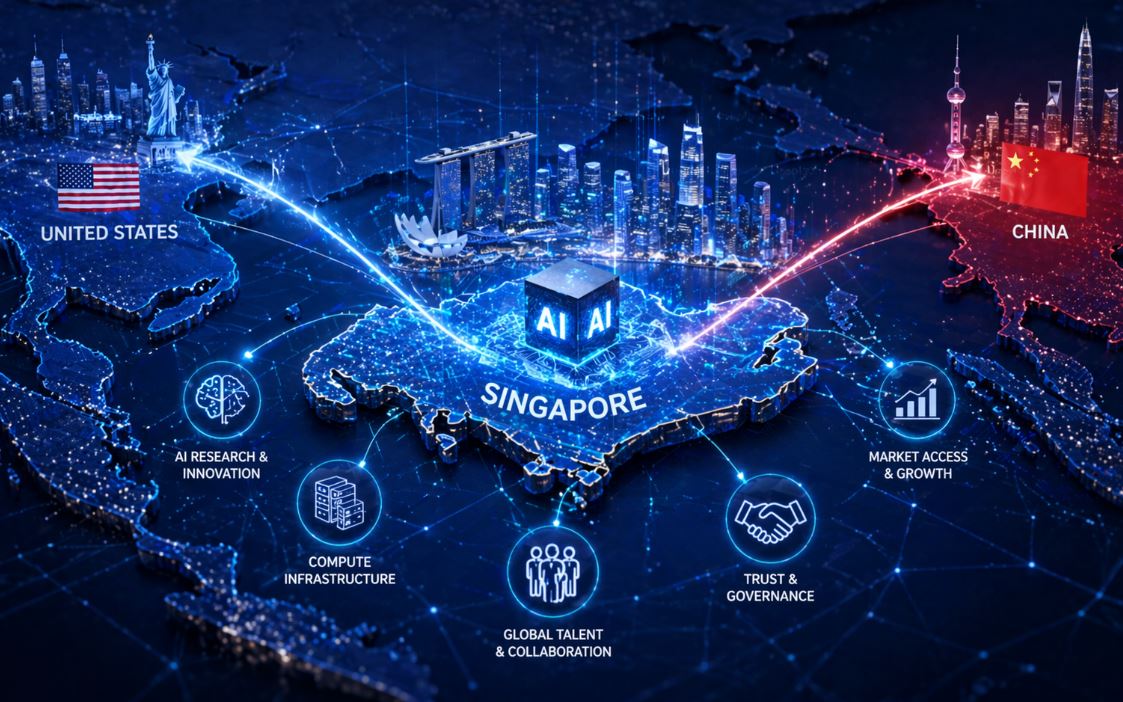
In a calm world, companies choose a base for efficiency. In a turbulent one, they choose a base for continuity. That is why Singapore’s position in the AI market is strengthening right now. The story is not only about funding or talent, although both matter. It is about a small state becoming a workable “neutral ground” at a time when the AI supply chain, capital flows, and even hiring decisions are being pulled into geopolitics.
The most immediate pressure is the rivalry between the United States and China. Export controls, investment scrutiny, and sensitive technology rules increasingly shape what companies can sell, where they can deploy, and who they can hire. For AI firms that want global clients, this is not an abstract debate. It affects procurement, enterprise risk committees, and the willingness of customers to sign long-term contracts. In that environment, Singapore offers something rare: a place that can host teams and partnerships without forcing every relationship into a political label. It is increasingly being used as a meeting point where companies can serve international customers, structure regional operations, and reduce the perception that they are operating under someone else’s national agenda.
That perception point is more important than many founders admit. When a multinational buys enterprise AI, they are buying more than model performance. They are buying governance, predictability, and the ability to explain to their board why a vendor is low-risk. In a year where global headlines include escalating conflict and sudden security shocks in key regions, customers naturally become more conservative. They want continuity of service, stability of contracts, and the confidence that their vendor’s operations will not be disrupted by political whiplash. Singapore’s appeal is that it remains boring in the best way. Rules are clear, institutions are consistent, and commercial disputes are handled in a way that international businesses recognise.
The second layer of advantage is execution. Singapore has been shifting its national AI agenda from experimentation to deployment, with a stronger emphasis on practical outcomes in sectors that matter: manufacturing, connectivity and logistics, finance, and healthcare. Instead of treating AI as a generic innovation theme, the country is building sector missions, governance structures, and public-private pathways that make it easier for solutions to move from prototypes into real workflows. For a young AI company, this is the difference between a nice demo and a credible reference client. For an international firm, it creates a path to pilot in a demanding environment and then scale across Southeast Asia.
Talent is the third layer, and it is where neutrality becomes operational. In a fractured world, people prefer locations that do not limit their future options. Singapore’s ability to attract international professionals, coupled with a strong pipeline of local upskilling, makes it easier for AI companies to build mixed teams. More importantly, it makes it easier to do so without building a workforce that is trapped inside one geopolitical corridor. The result is a talent strategy that feels more resilient: hire globally, serve globally, and reduce the risk that a sudden policy shift will cut off your capacity.
The final layer is business plumbing. AI firms may look like software companies, but their success depends on the basics: banking that works, cross-border payments that clear, corporate structures that investors understand, and compliance frameworks that do not collapse under scrutiny. Singapore remains one of the simplest places in Asia to combine these fundamentals with a tech-forward operating environment. In stable periods that is convenient. In unstable periods it becomes strategic, because operational friction is exactly what grows when the world turns defensive.
None of this suggests that Singapore is immune to pressure. A neutral ground remains neutral only as long as it is trusted by all sides, and that trust must be actively maintained. There is also a higher compliance bar for firms operating in sensitive domains, and for many AI businesses that is now part of the cost of going global. But the direction is clear. As geopolitical shocks ripple through supply chains and the US–China technology divide deepens, Singapore is positioned as one of the few places where AI companies can still build with international ambition without constantly renegotiating their identity.
For founders and executives choosing where to place an AI business in 2026, the argument is therefore less about chasing the largest market and more about securing the cleanest platform. If you can operate from a stable, trusted base, you can sell to more customers, attract more talent, and ride out more shocks. In the current environment, that stability is not just a comfort. It is a competitive edge.