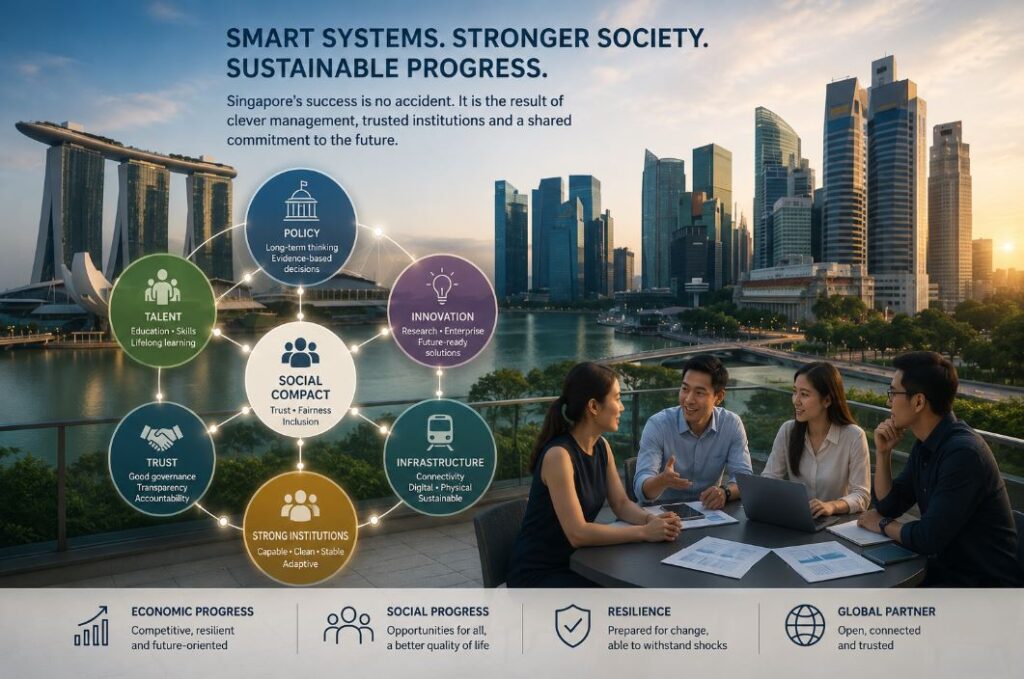
Singapore’s story is often told through outcomes: growth, safety, order, efficiency. But the deeper reason the city keeps compounding is not that it avoids mistakes. It is that it treats governance like a craft, and it keeps revisiting the craft as the world changes. That mindset sits at the heart of what many scholars have described as Singapore’s “management of success”: the deliberate shaping of policy, institutions, and social systems to deliver results, then the willingness to adjust those systems when yesterday’s formula stops matching tomorrow’s reality.
A useful way to think about it is that Singapore does not only build policies; it builds operating systems. When the operating system is coherent, citizens and businesses feel it in small, practical ways that compound. Processes are clear. Standards are consistent. Decisions are not always popular, but they are usually legible. That legibility matters more than most people realise, because it lowers friction across the entire economy. It makes it easier for companies to plan, hire, invest, and trade, and it makes it easier for individuals to trust that effort will not be wasted by sudden rule changes or administrative chaos.
This “systems first” approach has been refined over decades, but it has also been tested repeatedly. As Singapore moved past the early development years, the challenge was no longer basic growth. It became economic restructuring, managing global integration, keeping social mobility credible, and continuously renewing the relationship between state and society. Singapore’s leaders have had to navigate shifting global conditions, domestic expectations, and the tension that comes with success itself: higher costs, more competition for talent, and a population that demands not only results but dignity, fairness, and voice. The fact that Singapore has had multiple leadership transitions without losing institutional direction is part of what makes the model distinct. It suggests that the system is bigger than any one personality, which is precisely what long-term investors, entrepreneurs, and professionals look for.
In 2026, the same managerial discipline is being aimed at a new frontier: the cognitive economy. When AI becomes pervasive, the scarce resource is no longer information; it is judgement, coordination, and the ability to see second-order effects before they land. That is why Singapore’s emphasis on “critical core skills” and systems thinking resonates beyond education policy. It signals an intent to build not only technical competence, but a workforce and leadership culture capable of managing complex, interconnected environments. If you strip away the buzzwords, the ambition is old-fashioned: to upgrade how decisions are made, how organisations learn, and how public systems stay responsive without becoming unstable.
What makes this relevant to economic and social progress is that Singapore does not separate the two as neatly as many countries do. Social stability is not treated as a moral afterthought; it is treated as an input into competitiveness. A society that can handle change without fracturing is more attractive to capital, more attractive to talent, and more capable of reinvention. That is why Singapore’s model keeps returning to the idea of a social compact, even as it pursues global-city strategies. The compact is not static. It is re-negotiated through policies on labour, mobility, housing, education, and the role of foreign participation in the economy. The details evolve, but the underlying principle remains consistent: legitimacy must be maintained while the economy transforms.
This is also where customer and partner perception quietly amplifies Singapore’s advantage. When companies buy services from a Singapore-based firm, or route regional operations through Singapore, they are buying a kind of reliability that is hard to write into a contract. It shows up in how problems are escalated, how disputes are handled, and how predictable compliance feels. In a world where geopolitical shocks and supply-chain disruptions can turn operational risk into existential risk, that reliability becomes an economic product in itself. The “Singapore premium” is not only about tax or infrastructure; it is about the confidence that systems will keep functioning when the environment becomes less forgiving.
If there is a lesson in Singapore’s management style, it is that progress is not a single leap but a habit. The country’s most powerful advantage may be its ability to treat complexity as something to be designed for, rather than something to be endured. That habit has already delivered decades of economic growth. The question now is whether it can also deliver the next layer of social progress: a workforce that can adapt without fear, institutions that can modernise without losing trust, and a business environment that remains open while staying credible. Singapore is betting that clever management is not just how you get rich; it is how you stay resilient.